
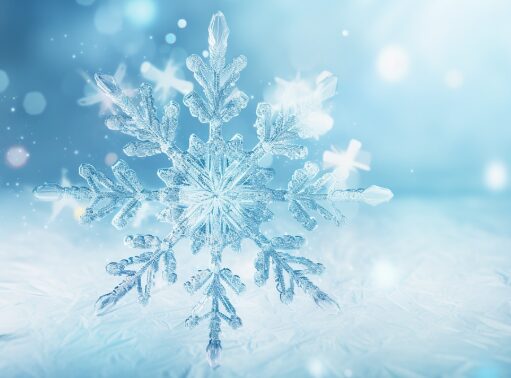
As I’ve noted previously, I love winter and layers of snow. The shivery cold, the drifts carved by wind, the thick blanket damping sound, and the gentle fall of flakes – those little snow fairies drifting to the ground. When the sun comes out, the glistening crystals reflect across the expanse, like a scattered field of diamonds. They shape into intricate carvings around tree and fence, scattered snow sculptures abounding. Thinking of snow and the snowflake, I’ve found an intriguing mirroring of human life in its unique beauty.
I have a good reason for loving winter and snow. I grew up in the country, surrounded by its pillowed beauty. It became a refuge during my growing up years, a playground of fluff to carve and shape and dig and roll in. Even the challenges of winter, the parts that needed patience and endurance, were a plus. In addition, my parents were strong, determined people and I assimilated some of those characteristics. I was set to like snow.
For those of you who dislike snow and cold, stay with me.
Here’s a few facts about snow and specifically, the snowflake, that tiny, creation that swirls about. While the special six-point shape of snowflakes was first described by the Swedish priest Olaus Magnus in 1555, we have Wilson Bentley to thank because in 1902 he figured out a way to capture and take pictures of snowflakes. He spent that winter taking hundreds of exquisite images of individual flakes. You can find them in his books and on the internet today.
He and others discovered that a snowflake originates from extremely cold water forming around a pollen or dust particle. It makes a symmetrical crystal built off of the water molecule, adding more facets as it falls towards earth. And amazingly, across the billions of snowflakes formed each winter, all have a unique, individual and complex shape. Scientists have identified eight broad classifications and at least 80 individual variants of the simple snowflake.
For me, it reveals a creative force that paints beauty with a common
brush across these unique tapestries.
While there is an ideal six-fold symmetric shape to each flake, only 0.1% of them are perfect – one in a thousand. The rest take on a myriad of variations that makes each one unique. The differences are due to the changing temperature, varying humidity, even different wind speeds as they journey down from clouds on the long journey to earth.
Here’s a fun fact: snowflakes are clear, not colored white. The reason we see white is because flakes reflect the full spectrum of light which our eyes see as white. Here’s another: there are almost one billion flakes within a cubic foot of snow! (No wonder a full shovel feels so heavy.)
Thinking about all those attributes of snowflakes made me think of our own human lives. There is an amazing mirroring between humans and snowflakes, despite our obvious differences. The commonalities between each’s beautiful forms and complex lifecycles is striking. For me, it reveals a creative force that paints beauty with a common brush across these unique tapestries.
Look at the snowflake – its many shapes are organized into a ‘family of flakes’ structure (there’s a joke in there someplace). While you can identify the different variants of a snowflake, they’re still a snowflake created by the same process. Isn’t that like humans with our many races spread across the globe? Each person has their own set of identifiable characteristics, yet all are distinctly human, all created the same exact way.
Even more tantalizing, while there is a perfect shape for a snowflake, only one in a thousand are unblemished. All those variables of temperature, wind, etc. mentioned above alter the snowflakes as they fall to earth. Look closely at a light dusting of snow on a windshield and notice how every flake is different, like tiny flowers, each with a unique shape, never to be repeated. In the Biblical origin story of creation, humans’ original ancestors Adam and Eve were once perfect, too. They became ‘imperfect snowflakes’ when they had to leave Eden. Since then, all of their children are imperfect humans; beautiful, intelligent, loveable but still imperfect.
Here’s one other similarity from a geological view: except for a few places on earth (the highest mountains, the poles, and glaciers), snowflakes melt away every year only to have nature create a new batch the next winter. We humans also die away every generation, our lives measured in decades, with more babies born each year in our place.
For me, this mirroring, the shared likeness of how inanimate and animate creations come into being and exist on earth, points to a Creator. While this mirroring may be more obvious across animal species and between ecosystems, to see it in a tiny snowflake with its delicate ice beauty and fragility touches something deep within me.
The next time you’re around snow, put on gloves, go outside, let them cool a bit, then catch or scoop up a few flakes and peek at them. You’ll be amazed at their stunning shapes, and maybe with their creator too.
———————————————
Note: the snowflake information and images come mostly from two websites: NOAA December 21, 2022 article, and Wikipedia.


Leave a Reply